

 admin
Published: 09 Sep, 2026
admin
Published: 09 Sep, 2026
Haridwar Kumbh 2027: Understanding the World’s Largest Spiritual Gathering
Once every six years, Jupiter drifts into Aquarius, the Sun crosses into Aries, and a stretch of the Ganga at Haridwar becomes, by Hindu reckoning, something more than a river. The Kumbh Mela is what happens when tens of millions of people decide to be there when it does.
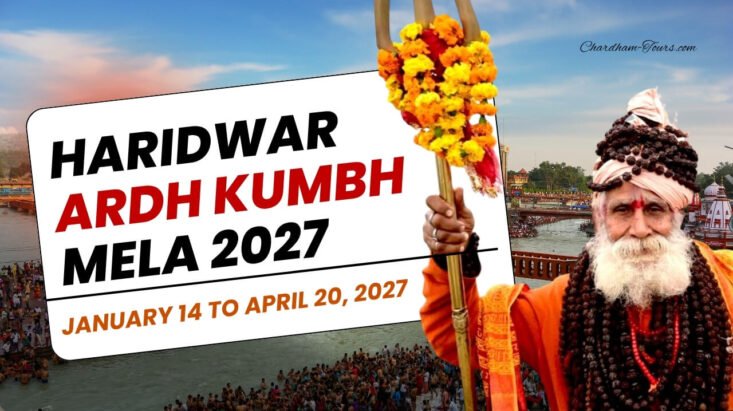
The next window opens on 14 January 2027 and closes on 20 April 2027, ninety-seven days across which a temple town of two hundred thousand becomes a temporary city of roughly ten crore. There are older festivals in the world, and there are larger cities, but there is nothing else that assembles a population this size around a single act of faith, holds it together for three months, and then disperses without a trace.
This is a guide to what the 2027 Haridwar Kumbh actually is, why it happens where it does, what a bathing day feels like from the ghats, and why the event holds its grip on travelers, photographers, and seekers who have no personal stake in the ritual. It is not a checklist for the logistics of your trip. Think of it as a way of understanding what you are looking at.
What the 2027 Mela (fair) Actually Is?
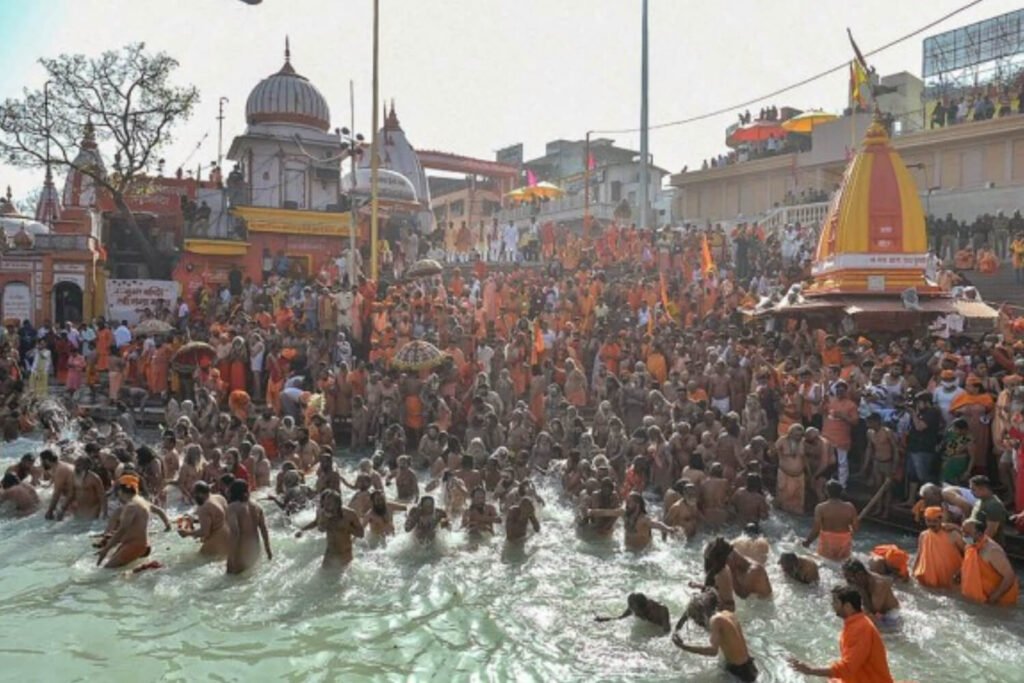
Technically, the 2027 gathering is an Ardh Kumbh, the half-cycle held six years after the last full Purna Kumbh at the same site (the previous one was in 2021, held under COVID-era restrictions). What makes 2027 unusual is that the Uttarakhand government and the Akhil Bharatiya Akhara Parishad have jointly decided to run it at the Purna Kumbh scale. All 13 Akharas will participate in a full royal bathing schedule usually reserved for the twelve-year cycle. Every operational parameter, from tent city size to pontoon bridges to sanitation grids, is being built to full-Kumbh specification.
One other change is worth noting up front. The old term “Shahi Snan” (Persian for “royal bath”) has been officially replaced with “Amrit Snan” (Sanskrit for “nectar bath”) across all government records, signboards, and Akhara notifications. If you come across the older term in a book or a news archive, it means the same thing. There are three Amrit Snans in 2027, on 6 March, 8 March, and 14 April, and around them the entire choreography of the mela is arranged.
The Legend Behind It All
The Kumbh is rooted in one of the great narrative arcs of Hindu cosmology, the Samudra Manthan, the churning of the cosmic ocean.
In the Puranic account, the Devas (gods) had grown weak and were losing their long conflict with the Asuras (demons). Lord Vishnu proposed an unusual alliance. If both sides joined forces and churned the primordial ocean, they could extract fourteen divine treasures, the most sought after being the Amrit Kalash, a pitcher holding the nectar of immortality. The Devas and Asuras used the great serpent Vasuki as a rope and Mount Mandara as the churning rod, and for what the texts describe as an epoch, they turned the ocean until it began to yield.
The churning produced strange things in sequence. First came the deadly poison Halahala, which Lord Shiva drank to save creation, the reason he is called Neelkanth (blue-throated). Then came the celestial cow Kamadhenu; the wish-fulfilling tree Kalpavriksha; the goddess Lakshmi; the moon; and finally, the physician of the gods, Dhanvantari, holding the Kumbh of nectar.
The moment the pitcher appeared, the truce collapsed. The Asuras seized the Kumbh, and a fierce battle broke out. To protect the nectar, Lord Vishnu’s mount Garuda (in some accounts, his son Jayanta) took the pitcher and flew for what the texts call twelve divine days, equal to twelve human years in Puranic time. During the flight, four drops of the amrit fell on Earth, at Haridwar, Prayagraj, Nashik, and Ujjain. These are the four Kumbh sites. The twelve-day flight is the reason the full Purna Kumbh rotates every twelve years.
The drop that fell at Haridwar is said to have touched the waters at Brahmakund, the central pool at what is today Har Ki Pauri. When Jupiter enters Aquarius and the Sun enters Aries, tradition holds that the memory of that drop returns to the water, and the Ganga at Haridwar briefly carries the vibration of amrit itself. In 2027, the peak of this cosmic window falls on 14 April. It is the reason that specific day is regarded as the most spiritually potent of the entire ninety-seven-day mela.
Haridwar Before Dawn: What a Bathing Day Feels Like
To understand the Kumbh, you have to understand the hours before sunrise on a bathing day.
- By 3 am the streets around Har Ki Pauri are already choked. Not with vehicles, which the authorities will have stopped 6 to 8 kilometers out, but with people walking in from the outer parking lots. Grandmothers wrapped in shawls; families holding hands in chains so nobody gets lost; sadhus with matted hair and no luggage; teenagers in synthetic tracksuits; and always, moving through it all, the low, continuous chant of Ganga Maiya ki jai. The winter mist lies thick on the river. The ghats are lit by yellow sodium lamps and by the ceremonial fires that burn all night at the akhara camps upriver.
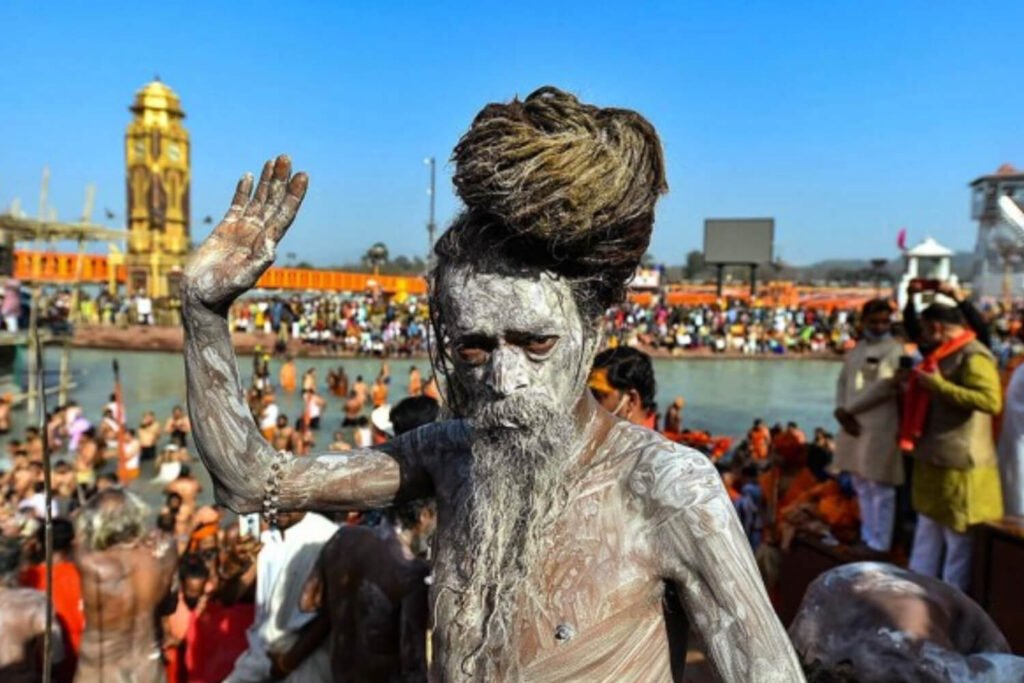
- On the three Amrit Snan days, everything else stops for the Peshwai, the ceremonial procession of the Akharas. The 13 orders arrive at Har Ki Pauri in a strict pre-decided sequence: on elephants, on horseback, on ornate silver chariots, and some walking on foot with tridents and conch shells. The Naga Sadhus lead. They come down from the Himalayan caves, where most of them spend the rest of the twelve-year cycle, their bodies covered in ash, weapons slung across their shoulders, moving through the crowd in a state of controlled exuberance that has no parallel in ordinary religious life anywhere in the world. Civilian bathing at Har Ki Pauri stops entirely during the procession. Millions watch in silence as the akharas step into the water in turn, first the Shaiva orders led by the Juna Akhara, then the Vaishnava Bairagis, then the Udaseen.
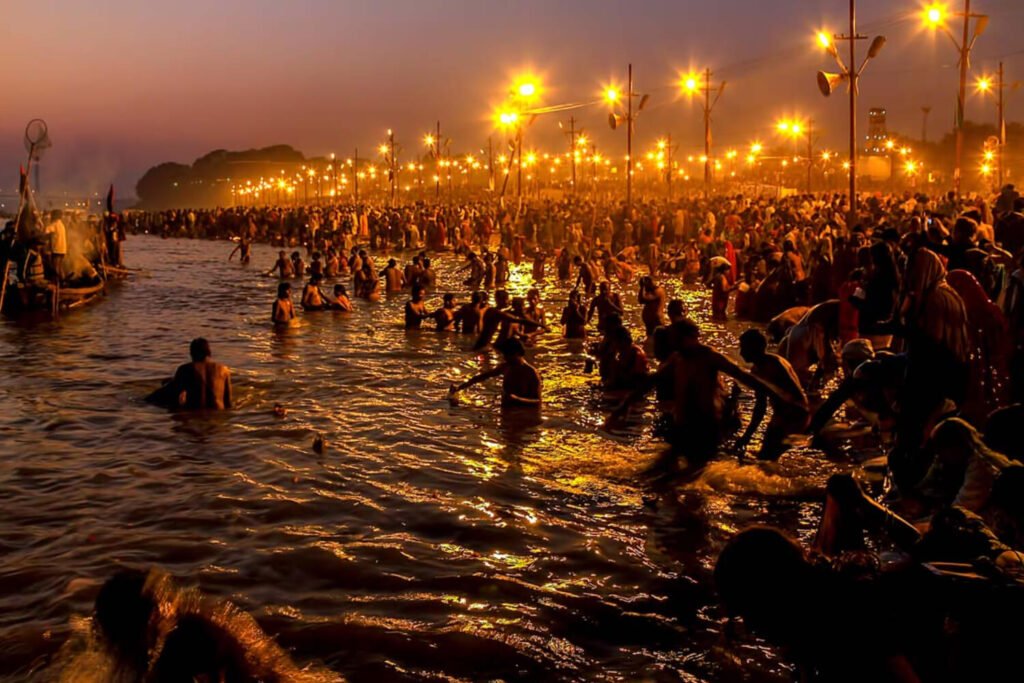
- By late afternoon the akharas have withdrawn, and the public bathing begins in earnest. On non-Amrit days the ghats remain open throughout, and the atmosphere shifts. Families guide elderly parents into the water, priests recite mantras for money and for free, first-time pilgrims stand at the edge for long minutes before stepping in, and children splash without any of the theological weight. The cold does not seem to register.
- Sunset is when the mela’s other face appears. The Ganga Aarti at Har Ki Pauri, ordinary and beautiful on any evening of the year, becomes something else during the Kumbh. Priests in saffron hold up brass lamps taller than they are. Thousands of small leaf boats carrying lit diyas float downstream at once. The chants rise in synchrony from both banks. If you are standing on the steps, you can feel it more than hear it.
- The rest of the night belongs to the akhara camps, spread across the 32 sectors that the mela grounds have been divided into. Wood fires burn continuously. Somewhere a Ramayana recitation is in its fifth uninterrupted hour. Somewhere else a philosophy debate is going on in Sanskrit. Bhandaras, the free community kitchens, serve hot khichdi and halwa to anyone who sits down.
The People You Meet at Kumbh
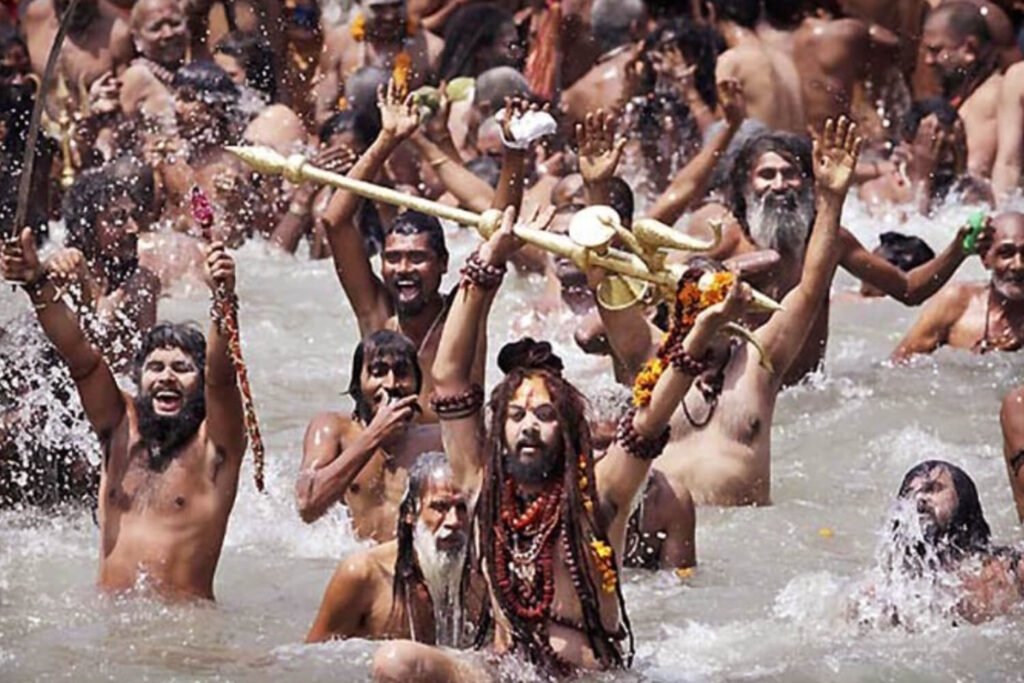
The Kumbh is, above everything else, a gathering of extraordinary human variety. You will meet, in a single afternoon, more distinct traditions of Hindu life than most people encounter in a lifetime.
- Naga Sadhus: Warrior ascetics of the Shaiva Akharas, ash-covered, mostly silent, and rarely seen outside the Kumbh. They live in remote Himalayan caves for most of the twelve-year cycle and descend only for the bathing days. Approach with respect and do not photograph without asking.
- Kalpwasis: Committed pilgrims who take a formal vow to stay at the mela for the full month of Magh, sleeping on straw cots in temporary huts, eating one meal a day, and following a strict discipline of bathing, meditation, and scripture reading. They are the mela’s spiritual backbone.
- Mahamandaleshwars and gurus: Senior spiritual leaders who hold court in large decorated tents, giving daily discourses, receiving disciples, and drawing crowds that would embarrass most politicians.
- Ordinary pilgrims: Families from rural Rajasthan, Bihar, Odisha, and Andhra, who have saved for years for this trip. Many arrive by special Kumbh trains, sleep on station platforms, and treat the whole thing with a matter-of-fact devotion that leaves visiting anthropologists rethinking their notes.
- Spiritual seekers: Yoga practitioners, meditation students, and Vedanta enthusiasts who camp at temporary ashrams for the philosophical discourses that run all day at Shantikunj, Patanjali Yogpeeth, and dozens of smaller centers.
- International visitors: Documentary filmmakers, photojournalists, anthropologists, and curious travelers from Europe, the Americas, and East Asia. The Kumbh has been documented by everyone from National Geographic to Werner Herzog, and there is always another crew working.
What you notice quickly is that these groups do not stay separate. The Kumbh is one of the few places in India where a French photographer, a Bihar farmer, a Naga sadhu, and a Bangalore techie on a spiritual sabbatical can end up eating the same free meal on the same mat at the same bhandara. That crossover is part of the point.
Beyond the Holy Dip: The Cultural Life of the Mela
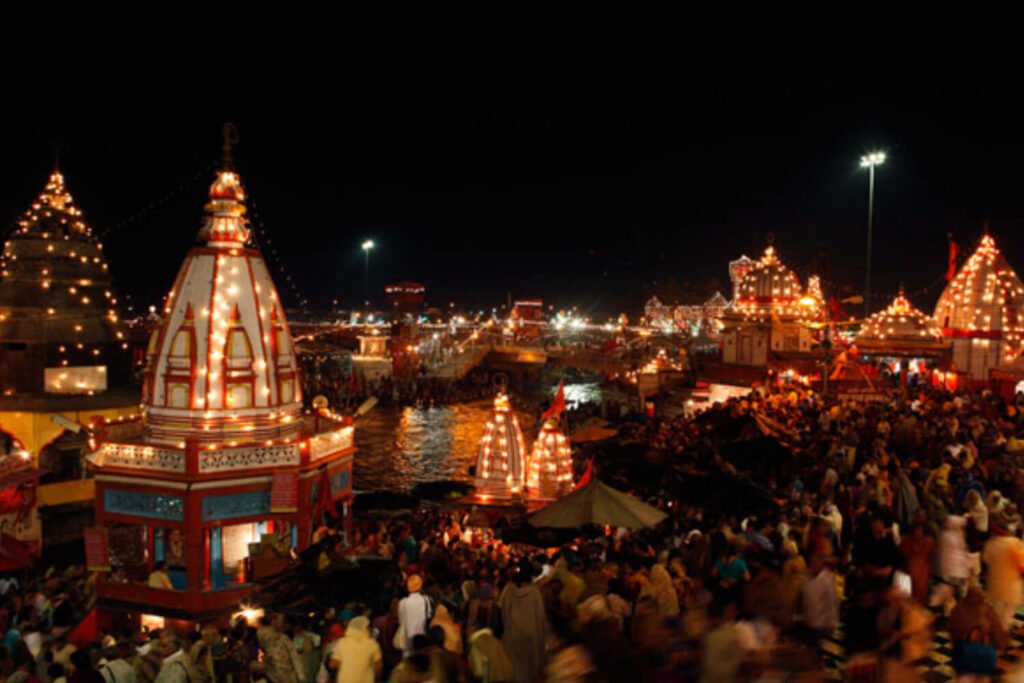
The bath is the ritual center, but it is not the whole event. Between the ten major bathing days, a parallel cultural life fills the mela grounds.
- Attend a Katha or Pravachan, the daily storytelling and philosophical discussions held under enormous canvas tents by the country’s leading gurus. Most are free and open to anyone who walks in.
- Sit through a classical music evening in the state-designated cultural zones, where Hindustani vocalists and instrumentalists perform, often to audiences of tens of thousands.
- Watch Uttarakhandi folk dance troupes perform Chholiya and Jhora at the state pavilions, easy to combine with a walk through the craft markets nearby.
- Browse the Rudraksha bead markets near Kankhal, where sellers from Nepal and eastern Uttarakhand set up stalls with beads of every mukhi count.
- Pick up spiritual literature from the Gita Press and other publisher stalls, which discount their catalogs heavily during the mela.
- Join a community bhandara meal, the free vegetarian kitchens run by ashrams and volunteer groups that operate around the clock.
The mela is also, by design, one of the great periodic revivals of Sanskrit scholarship in India. Debates and recitations that would draw a dozen people in an ordinary year draw thousands here.
Haridwar Kumbh Mela 2027 Important Bathing Dates (Amrit Snan)
|
Date |
Occasion |
What the Day Marks |
|
14 January 2027 |
Makar Sankranti |
The sun’s transition into Capricorn. Traditional first bath of the winter pilgrimage season. |
|
6 February 2027 |
Mauni Amavasya |
The silent new moon. Considered among the most spiritually charged Amavasyas of the year. |
|
11 February 2027 |
Basant Panchami |
The arrival of spring, dedicated to Saraswati, goddess of learning. |
|
20 February 2027 |
Magh Purnima |
The full moon of Magh, closing the traditional month of Kalpwas. |
|
6 March 2027 |
Mahashivratri (1st Amrit Snan) |
The great night of Shiva. Akharas process for the first time. |
|
8 March 2027 |
Somvati Amavasya (2nd Amrit Snan) |
A rare new moon that falls on a Monday, sacred to Shiva. |
|
7 April 2027 |
Nav Samvatsar |
The Hindu New Year (Chaitra Shukla Pratipada). |
|
14 April 2027 |
Mesh Sankranti / Baisakhi (3rd Amrit Snan) |
The peak of the Kumbh cosmic window. The single most sacred day of the mela. |
|
15 April 2027 |
Ram Navami |
Birth of Lord Ram. |
|
20 April 2027 |
Chaitra Purnima |
The full moon is closing the Mela. |
The three Amrit Snan days are when the mela hits its extreme intensity. If you have flexibility, the seven surrounding auspicious days offer nearly the same atmospheric charge with more breathing room.
Around Haridwar: The Slow Detour
Haridwar sits at the edge of the Himalayan foothills, and the surrounding region offers some of the finest counterpoints to the mela’s intensity that you will find anywhere in India. If you have more than three or four days, plan at least one out of them.
- Rishikesh, twenty-five kilometers upstream, is where the Ganga is younger, faster, and greener. The suspension bridges of Ram Jhula and Lakshman Jhula, the ashrams of Parmarth Niketan and Sivananda, and the international yoga schools around Tapovan give the town a global counterculture flavor that is the opposite of Haridwar’s dense orthodoxy. The Ganga Aarti at Parmarth Niketan’s Triveni Ghat is smaller, calmer, and, in the view of many regulars, a more contemplative experience.
- Rajaji National Park, whose main gates lie just outside Haridwar, is a genuine surprise. Wild elephants, leopards, sambhar deer, and, if you are very lucky a tiger, in a sal forest that stretches from the Ganga to the Yamuna. A half-day jeep safari makes for a quiet contrast to the mela.
- Devprayag, seventy kilometers upstream, is the confluence of the Alaknanda and Bhagirathi rivers where they officially become the Ganga. Uncrowded, ritually significant, and photographable in a way Haridwar rarely is.
- Neelkanth Mahadev Temple, above Rishikesh in the Manikoot hills, is the traditional site where Shiva is believed to have drunk the Halahala poison during the Samudra Manthan. Closing that mythological loop while you are in the region is worth the drive.
What Haridwar Tastes Like?
Haridwar’s food is strictly vegetarian, largely satvik (no onion or garlic in the temple-adjacent food), and among the most enjoyable street eating in northern India. During the mela, food stalls multiply across the sectors, but the classic addresses are on Upper Road, Bara Bazaar, and around Moti Bazaar.
Order hot jalebis from Mathura Walon Ki Prachin Dukan, in business since 1925 and still frying in pure ghee. Pair a plate of kachori-sabzi with cold kesariya lassi at Mohan Ji Puri Wale. Try aloo puri and rabri for breakfast at the crowded stands near Har Ki Pauri. Pick up peda and sohan halwa for the trip home. On a cold February morning, a small paper cup of masala chai from any stall near Bhimgoda is worth walking half a kilometer for.
The bhandaras, the free community kitchens, are also very good. The food is usually simple khichdi, kadhi, sabzi, and roti, cooked at industrial scale by volunteers, and it comes with a specific kind of Kumbh-only flavor that regulars say is impossible to reproduce at home.
Why Even Non-Pilgrims Should Consider Going?
You do not have to be Hindu, or religious, or spiritually inclined in any conventional sense, to find the Haridwar Kumbh genuinely worthwhile. The reasons pile up quickly once you are there.
For anyone interested in urban planning and mass logistics, the Kumbh is a working seminar in temporary civic infrastructure. A city of ten crore people appears out of paddy fields in ninety days, functions without a serious breakdown for three months, and vanishes. Nobody else in the world attempts anything on this scale. The 2027 Mela’s use of 32 autonomous sectors, AI-based crowd monitoring, and pontoon bridge density sensing will be studied by disaster planners and urbanists for years.
For photographers and documentary makers, the density of visual material is difficult to overstate. Naga Sadhus at dawn, akhara chariots in golden hour, the aarti at Har Ki Pauri, and the sheer human variety of the pilgrim crowds are all there in one geography.
For cultural anthropologists and religion scholars, the Kumbh is the only place on Earth where the full living breadth of Hindu ascetic and philosophical tradition is on display at once. The 13 Akharas, the four Peethas, the various Sampradayas, and the folk-religious practices from every corner of the subcontinent are all within walking distance.
For ordinary travelers, the Kumbh is a rare kind of witness. You are watching something old, at a scale that has not diminished, being carried out with a seriousness that most modern life has forgotten how to hold. Whether or not you share the belief, the fact of the belief is worth traveling for.
This guide is written for understanding rather than for logistics. If you are ready to commit to attending, the operational details, when to book, how to get from the airport, which ghat to bathe at, what to pack, and how to plan for elderly parents or first-time visitors, are covered in a separate planning guide. The short version is that accommodation on and around the three Amrit Snan days will close out by autumn 2026 and that trains from Delhi and Dehradun will need to be booked at least three months ahead of your intended travel window.
For the ninety-four other days of the mela, planning is genuinely possible closer to the date, and the experience remains extraordinary.
Frequently Asked Questions About Kumbh Mela
Is the Haridwar Kumbh worth attending if you’re not particularly religious?
Yes, arguably more so. The Kumbh is one of the few remaining events on Earth that operates at a pre-modern scale and pre-modern seriousness. Non-pilgrims describe it variously as the greatest photography assignment of their careers, the most sustained lesson in mass civic organization they’ve ever seen, and the strongest single argument that traditions of this size can still function. You do not have to bathe. You do not have to believe. You do have to be prepared to observe carefully and without cynicism.
Which days are quieter if I want to experience the mela without extreme crowds?
The three Amrit Snans (6 March, 8 March, 14 April) will run at peak density and are best watched rather than participated in. The seven other bathing days sit at what one might call intense-but-manageable levels. For the calmest Mela experience with the full atmospheric charge, come mid-week between 15 February and 5 March, when the Kalpwas month is in full swing but no major snan is imminent. You will get the aarti, the discourses, the akhara camps, and the food without the crush.
When is the best window for photography?
Two windows matter. The blue hour before dawn on Amrit Snan days for the akhara processions requires you to be in position by 3 am and comfortable with dense crowds. And golden hour on any non-snan day for portraiture at the ghats, ashrams, and bhandaras. Ask before you photograph sadhus and never use flash during rituals or aarti.
How does the Haridwar Kumbh compare to Prayagraj or Nashik in feel?
Prayagraj (Sangam) is larger and more diffuse, spread across the sandy floodplain where the Ganga meets the Yamuna. It has more space and slightly less intensity. Nashik is smaller, more Shaivite in character, and less commercially developed. Haridwar sits in between in scale but is arguably the most visually concentrated of the three, because the ghats are packed into a narrow riverfront hemmed in by hills. If you want the mela at its most iconic and photogenic, Haridwar is the strongest choice.
Can I attend the Ganga Aarti at Har Ki Pauri daily during the mela?
Yes, on all non-Amrit Snan days. Arrive at least ninety minutes before sunset for a spot on the steps, or watch from the far bank for a wider view. On the three Amrit Snan evenings, aarti access at Har Ki Pauri is restricted by pass-controlled entry, and it’s usually easier to attend one of the smaller evening aartis at Bhimgoda, Kushavarta, or Parmarth Niketan in Rishikesh.
What’s the one thing most first-time visitors say they wish they had known?
That the Kumbh is not one event but hundreds of overlapping ones and that trying to see everything is the mistake. The pilgrims who leave the mela most fulfilled are usually the ones who picked two or three specific experiences (one Amrit Snan viewing, one guru’s Katha, one Kalpwasi camp, and one bhandara meal) and gave them their full attention, rather than the ones who tried to attend all ten bathing days.



 Share
Share Home
Home Packages
 Book Now